

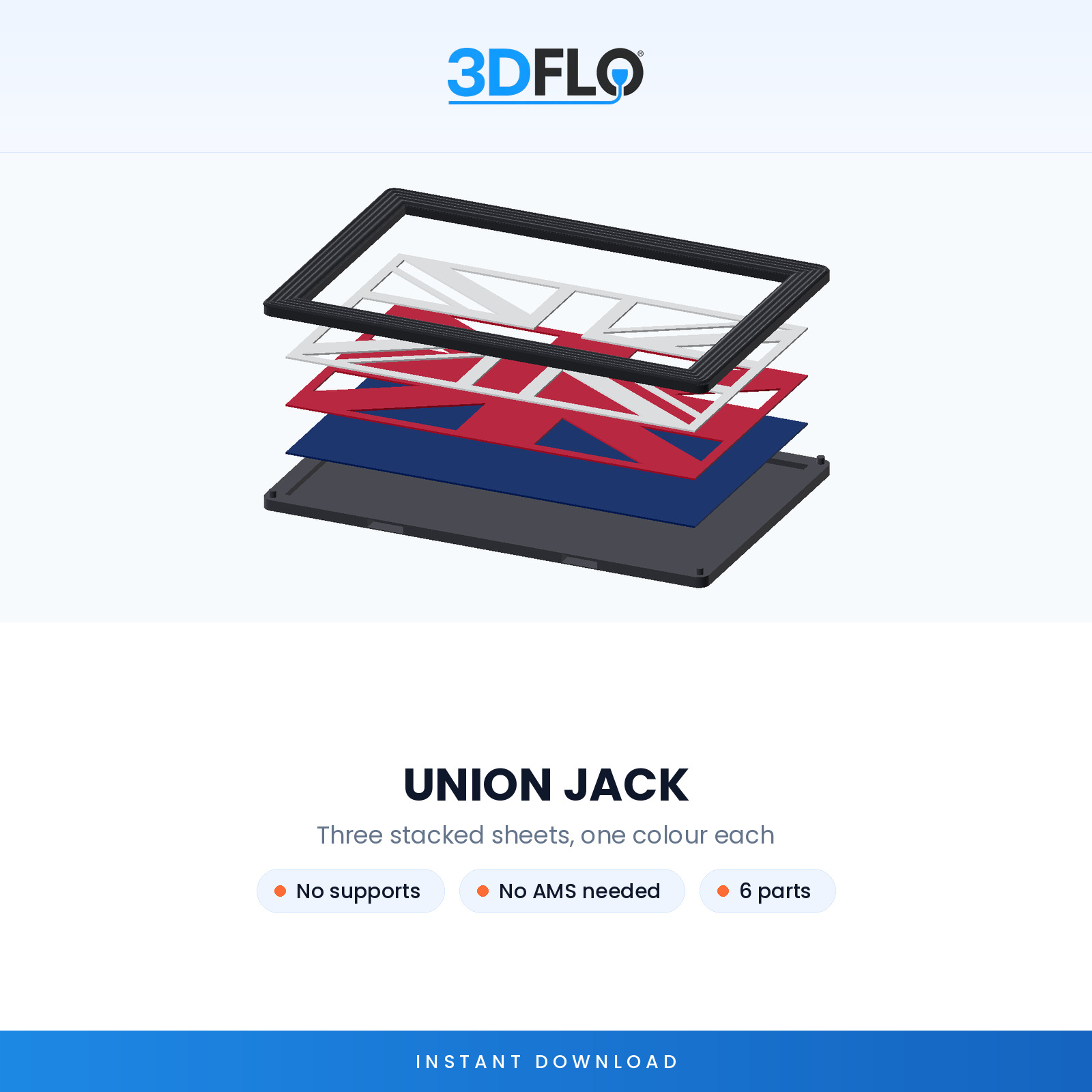

UNION JACK Flag Layered Art — STL Files (Digital Download)
Price range: £6.99 through £29.99
Description
The flag
Three saints, two unions, and one very easy mistake
The flag is three crosses laid on top of one another. St George’s red cross for England and St Andrew’s white saltire for Scotland were put together by royal decree in April 1606, when one king came to hold both crowns. St Patrick’s red saltire was added on 1 January 1801, the day the union with Ireland took effect — and that second version is the flag we still fly.
Look closely at the diagonals and you will see the red is not centred on the white. It is offset, and the offset swaps sides across the middle of the flag, so that neither Scotland’s cross nor Ireland’s sits squarely on top of the other. That small pinwheel is the whole reason the Union Jack has a right way up: the broad white diagonal belongs uppermost on the side nearest the flagpole. Get it wrong and turning the flag round will not save you — rotating it gives you the same wrong flag again. You would have to turn it over.
This one is cut to the official construction — six units for the cross, two for the white fimbriation either side, and a diagonal of white-red-white in three, two and one — and the sheets only stack one way round, so it comes out the right way up every time.
Designed and test-printed in Swansea.
Three picture sheets — blue, red, white
Base board with the 3DFLO mark on the back
Border ring with a reeded moulding
Weighted stand the frame drops into
Illustrated instructions, checklist and licence
If you can print a 256 mm square, you can print all of it. Everything lies flat.
252 × 164 mm
1.05 mm thin
none, anywhere
0.4 · 0.20 mm
Additional information
| Type of licence | Personal, Commercial |
|---|
Related products
-
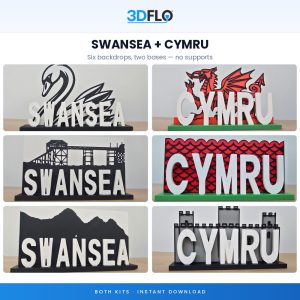

SWANSEA + CYMRU Bundle — STL Files (Digital Download)
Price range: £11.99 through £49.99Select options This product has multiple variants. The options may be chosen on the product page -

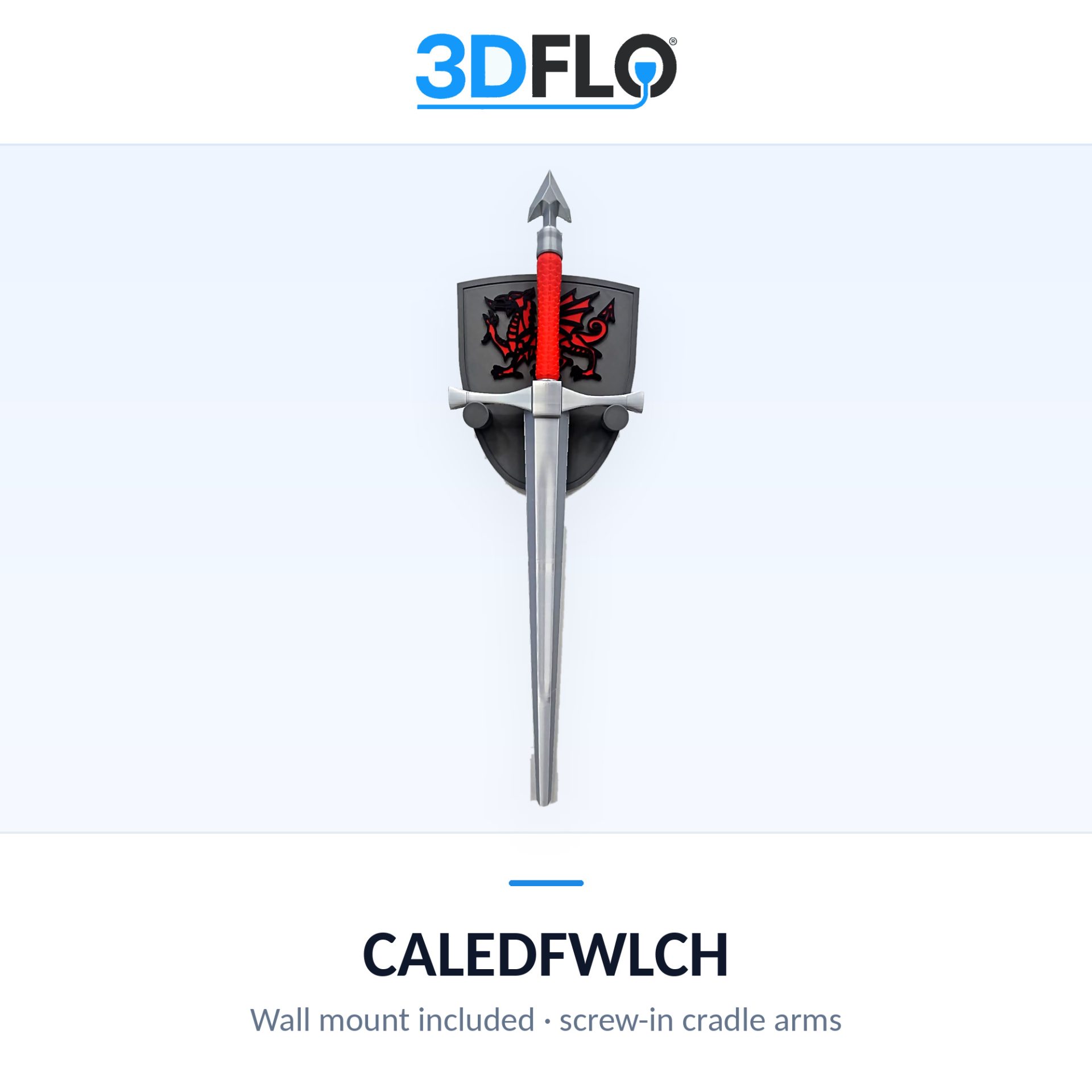
CALEDFWLCH Welsh Sword Kit — STL Files (Digital Download)
Price range: £12.99 through £29.99Select options This product has multiple variants. The options may be chosen on the product page -

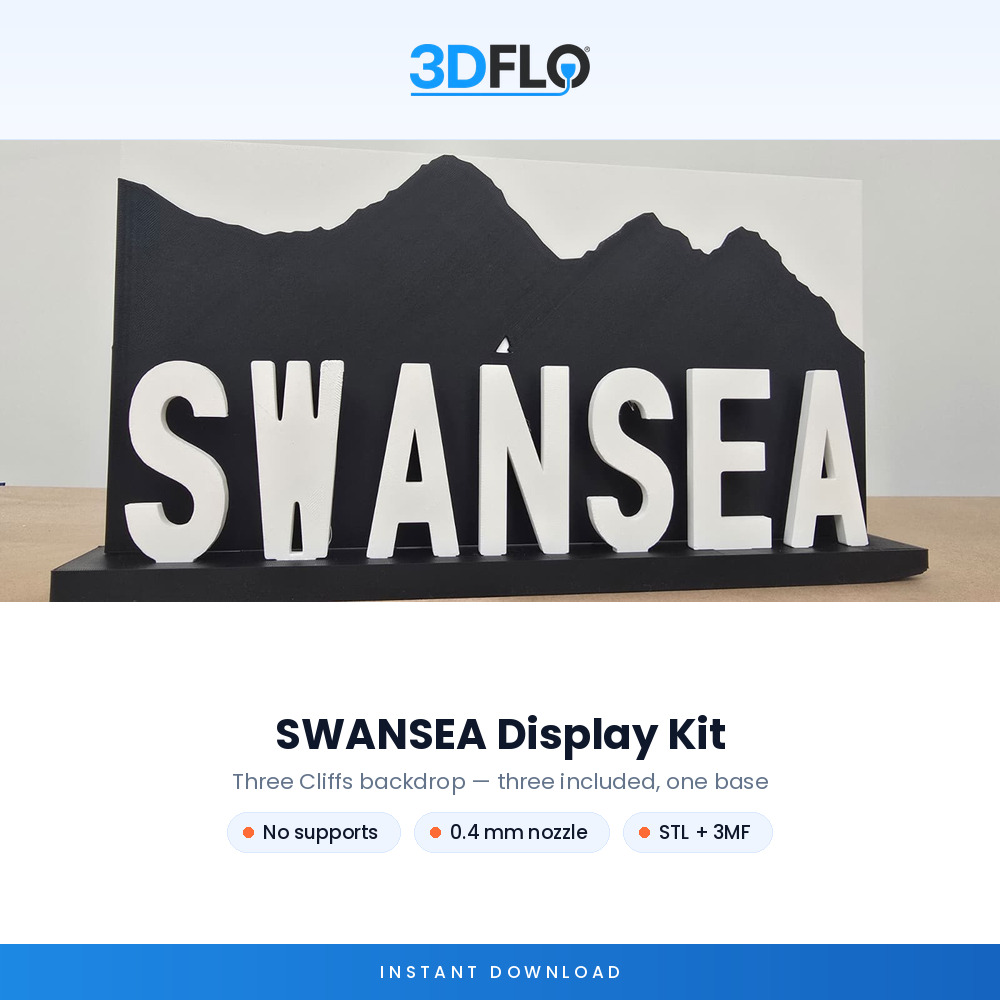
SWANSEA Display Kit — STL Files (Digital Download)
Price range: £6.99 through £29.99Select options This product has multiple variants. The options may be chosen on the product page -


COEDEN NADOLIG Spiral Christmas Tree — 3D Print STL Files (Digital Download)
Price range: £6.99 through £29.99Select options This product has multiple variants. The options may be chosen on the product page